
In the open, $200–$500
A visible, reachable burst, garden, garage, accessible wall, cut out and repaired at business-hours rates.
Water finds the ceiling fast and the cause slowly, the wet patch is almost never over the split. We shut it down, trace the failure to its source, and repair the pipe rather than bandaging the symptom. Around the clock across Burwood Heights and the Inner West.
Most of what bursts around Burwood Heights is age meeting pressure. Original copper lines from the mid-century build era wear thin from the inside until a pinhole opens; older galvanised steel rusts until a fitting lets go; and garden poly lines split where a root or a shovel found them years ago. Add mains pressure that runs high across parts of the Inner West, and the weakest point eventually announces itself.
The catch is that water travels. It runs along the outside of the pipe, along joists and wall plates, and surfaces somewhere downhill of the actual split, which is why the wet patch on the ceiling is so often metres from the leak. Repairing where the water shows up fixes nothing. We trace the line back to the failure itself, repair that, and pressure-test before closing anything back up.


If your pipework has failed more than once, note what the weather had been doing. Movement-driven failures come after the ground has changed volume, not after a particularly cold night: Sydney does not freeze pipes.
The heavy clay soil beneath Burwood Heights swells and shrinks through wet and dry spells, shifting and fracturing buried drainage lines.
Knowing that changes the repair. A joint that has been pulled apart by movement will be pulled again, so the fix is flexibility at that point rather than a rigid replacement of the same design.
Old pipework often fails within weeks of building work, and it is rarely the builder's fault. Vibration, a wall opened up, or the water simply being turned off and back on is enough to dislodge scale that was holding a corroded section together.
Burwood Heights’ interwar and Federation homes still run original earthenware pipework that cracks and collapses as it ages.
If you are renovating an older home around Burwood Heights, the cheap moment to replace accessible pipework is while the walls are already open. It costs a fraction of doing it later and it removes the section most likely to fail next.
Not every escape of water is a burst pressure pipe. A cracked or collapsed drain leaks too, slowly, without a pressure drop, and often for months before anything shows.
The distinction matters because the repairs are different jobs at different prices. A pressure leak shows on the meter with every tap closed; a drain fault does not, and it is found with a camera rather than a listening device.
On a slab home in reactive ground, differential movement between the slab and the surrounding soil is a real force acting on anything crossing that boundary. Pipes entering the slab edge take the strain.
A leak under a slab is the expensive version of this problem, and it is worth finding precisely before anyone cuts concrete. Acoustic and thermal location gets it to within a small area, which is the difference between a patch and a floor.
Burwood Heights is a small residential pocket of Sydney’s Inner West (postcode 2136), sitting between Burwood, Croydon Park and Enfield. Its quiet streets are lined with interwar and Federation homes on settled blocks, solid houses whose original drainage is now well past its prime, and we know the local ground well.
Most heritage-era houses are a layered record of every plumber who has worked on them: original galvanised in the untouched parts, copper from a seventies bathroom, and modern pex from whatever was done last.
That matters because a burst tells you about one section, not the house. We will say which era failed and whether the rest of that era is still in service, which is the difference between a repair and an informed decision about the next five years.
Reactive soil swells when wet and shrinks when dry, and it does not do either evenly across a block. Pipes bedded in it are pulled at their least flexible points, which are the joints and the places where a line enters a slab or wall.
The failures cluster at the change of season rather than in the depths of either one. A long dry spell broken by heavy rain is the classic trigger.
A serious water leak is an urgent repair under NSW residential tenancy law. The landlord or agent is obliged to arrange it promptly, and your first call is to them.
If they cannot be reached and water is actively causing damage, tenants may arrange urgent repairs up to a legislated limit and seek reimbursement. Isolate the water, keep the invoice, and record your attempts to contact them: we timestamp ours.
A visible, reachable burst, garden, garage, accessible wall, cut out and repaired at business-hours rates.
Adds the tracing and the careful access: finding the true split before opening anything, so only one hole gets made.
Detection gear, concrete access or a reroute. Precision here is the whole cost battle, small hole, right place.
Roughly $180–$250/hr against $120–$160 daytime, plus call-out. With the meter off, morning is sometimes the smarter spend, we will tell you honestly.
Leak detection's first hour, locating the failure before demolition, reliably cheaper than exploratory holes.
Every repair ends the same way: holding mains pressure on a gauge, under a lifetime workmanship warranty. Figures here are indicative of the 2026 Sydney market rather than a quote from us, you get your own number as a fixed price before any work starts.
On the phone: meter valve, clockwise, done: the flooding stops before we have left the depot. On site, we isolate just the affected line where possible so the rest of the house stays on.
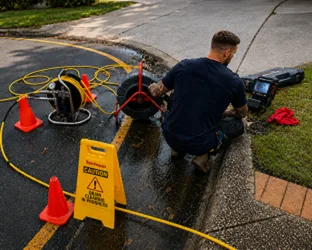
Water surfaces downhill of the failure, so we trace: acoustic gear, thermal imaging or pressure testing for concealed lines, before anything is opened up.

The failed section is cut out and replaced, not bandaged. If what we expose says the whole run is at end of life, you get that assessment straight, with numbers for both paths.
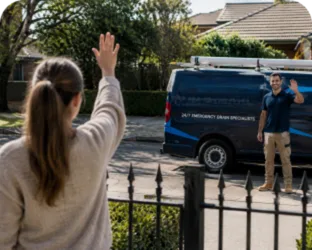
Pressure-tested against the mains before any wall, floor or trench is closed. You see it holding before we leave.
The hard part is done, the water has stopped. Call, and we plan the repair with you before anything else gets wet.
Water off? Good: now let us get it back on. Fixed price before the repair starts, pressure-tested before we leave.

Leave your details and our local Burwood Heights team will call you back fast.